
1. Company and SCADA Project Overview
Background
Warren E&P Inc. is an independent oil and gas operator based in Southern California. One of its most important production assets is the Wilmington Townsite Unit (WTU), which produces approximately 1,500 barrels of oil per day and operates continuously under active regulatory oversight.
At this scale, operational visibility is not optional. The company’s SCADA system is the primary interface for monitoring production, tracking pressures and flows, managing alarms, and responding to field issues in real time.
Project Motivation
The existing environment was becoming increasingly expensive and complex to maintain. Licensing costs were rising, infrastructure risks were growing, and architecture had become difficult to troubleshoot.
Leadership began evaluating whether continuing to invest in the legacy platform made long-term operational sense.
2. Problem Definition
Key Challenges
Escalating Licensing Costs: Wonderware deployment relied on a traditional per-tag and per-client licensing model. As the system grew, so did the cost.
Specialized Maintenance Requirements: The environment relied on multiple interconnected components, including ArchestrA Galaxy services, DAServers, and external communications layers. Troubleshooting failures often meant navigating a long chain of dependencies.
Infrastructure Risk: The aging infrastructure introduced potential single points of failure. If the Galaxy environment experienced a major problem, operators risked losing visibility into field operations.
Interim Solutions
Prior to the migration, Warren E&P maintained the system through incremental fixes and internal support. While this kept operations running, it did not address the root causes: architectural complexity, vendor lock-in, and rising cost.
“The system was brittle. When things broke, troubleshooting the communication chain between Wonderware, KEPServerEX, and the PLCs was painful.”
-VP of Operations, Warren E&P Inc.
3. Decision-Making and Solution Selection
Selection Criteria
When evaluating potential replacements, several factors mattered most:
Cost Structure: Leadership wanted to eliminate the restrictive licensing model and create predictable long-term costs.
Architecture Simplicity: Reducing system complexity would improve reliability and make troubleshooting easier for internal teams.
Industry Adoption: The platform needed strong adoption within oil and gas to ensure availability of integrators and long-term support.
Scalability: The solution needed to support future acquisitions and standardization across facilities.
Process
After evaluating alternatives, Warren E&P selected Ignition by Inductive Automation.
Ignition addressed the company’s key concerns:
• Unlimited tags and clients
• Simplified architecture
• Modern web-based access
• Broad adoption across industrial automation
The platform also aligned with leadership’s longer-term vision of standardizing SCADA across multiple assets. However, there was one major constraint - Speed.
“I didn’t want a six-month implementation dragging on in the background. I needed a partner who could get in, execute cleanly, and hand us back a working system quickly.”
-VP of Operations, Warren E&P Inc.
4. Implementation Process
Execution Strategy
The strategy focused on rebuilding the SCADA environment within Ignition while maintaining operational visibility throughout the transition.
Key elements of the implementation included:
• Full HMI reconstruction
• Clean tag architecture
• Alarm system redesign and rationalization
• Historian configuration
• Role-based access control
• Operator training and system handoff
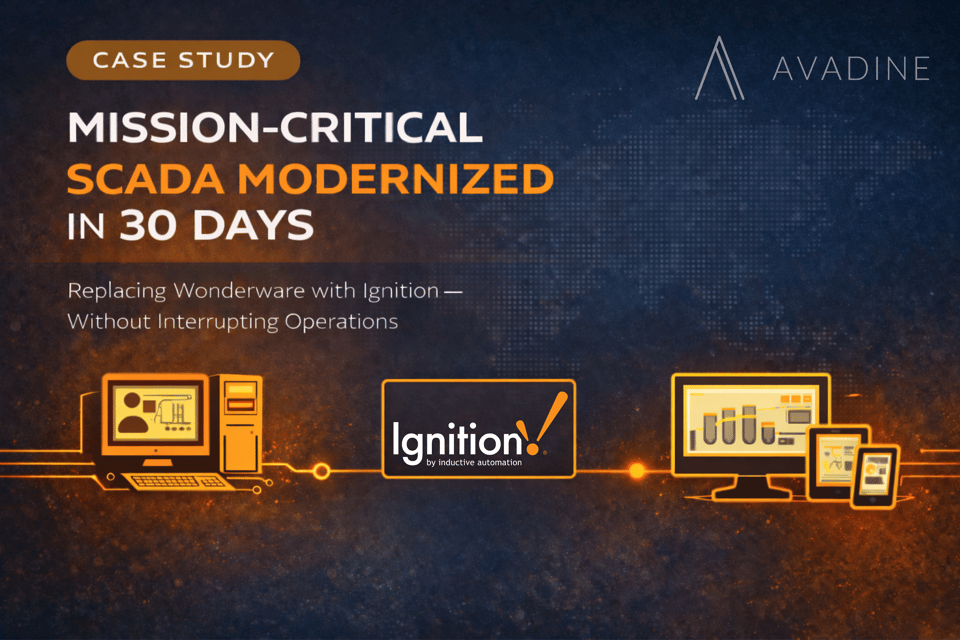
Despite the scope of the work, the entire system migration from legacy Wonderware to production-ready Ignition was completed in approximately 30 days.
“When I first scoped this internally, I was preparing for a multi-month effort. Completing the full migration in roughly 30 days was impressive.”
-VP of Operations, Warren E&P Inc.
Challenges and Solutions
The biggest challenge was ensuring there was no loss of operational visibility during the transition. Because the facility runs continuously, extended cutover windows were not an option.
Migration required careful planning, system validation, and coordinated deployment to ensure operators always had access to real-time information. The result was a seamless transition.
“We replaced an aging, expensive Wonderware SCADA system with Ignition in 30 days, without losing a minute of operational visibility.”
-VP of Operations, Warren E&P Inc.
5. Technical Architecture and Components
Key System Components
The new architecture centered on Ignition as the core SCADA platform.
Major components included:
• Ignition Gateway
• Web-based Perspective HMI interfaces
• Integrated historian
• Structured tag architecture
• Alarm management system
• PLC communications layer
Compared to the previous layered architecture, the new system significantly simplified communications and reduced system dependencies.
This simplification improves both reliability and maintainability.
Security Measures
The system also introduced improved user access controls through role-based permissions and centralized authentication within the Ignition platform.
Combined with browser-based access, this allowed operators and leadership to view system information securely without relying on dedicated SCADA clients.
6. Results and Impact
Operational Improvements
Web-Based Accessibility: Operators can now access the system from any authorized browser or tablet rather than relying on dedicated client installations.
Improved Alarm Management: Alarm rationalization reduced nuisance alarms and improved prioritization.
Operator Adoption: The modern interface made adoption easier than expected.
Reliability: System stability has improved significantly.
“The transition was smoother than I anticipated. The interface is modern and responsive. Operators picked it up quickly…Superior in both dimensions. The system has been rock-solid since deployment.”
-VP of Operations, Warren E&P Inc.
Cost and Time Savings
Lower Total Cost of Ownership: By eliminating per-tag and per-client licensing, Warren E&P significantly reduced ongoing SCADA costs.
Reduced Operational Risk: The new architecture removed legacy single-point-of-failure risks and simplified system troubleshooting.
Standardization for Future Facilities: Ignition now serves as a template for future deployments.
“Avadine delivered a cleaner, more reliable platform at a fraction of the ongoing cost, and our operators prefer it.”
-VP of Operations, Warren E&P Inc.
7. Future Prospects
• Expanding Ignition to additional oil fields
• Standardizing SCADA across operations
• Implementing production analytics
• Automating reporting
• Integrating future acquisitions
8. Lessons Learned & Recommendations
Key Takeaways
This project demonstrates several important lessons for industrial operators:
• Large SCADA migrations do not have to take six months.
• Mission-critical facilities can modernize without losing visibility.
• Licensing models can significantly impact long-term cost.
• Simplified architectures improve reliability and troubleshooting.
• Modern HMIs drive faster operator adoption.
Advice for Similar Companies
For operators still running legacy SCADA platforms, the Warren E&P experience offers a clear takeaway:
Waiting often increases both risk and cost.
“If another operator asked me about migrating off Wonderware? Do it. The longer you wait, the more risk and cost you carry.”
-VP of Operations, Warren E&P Inc.