
1. Company and SCADA Project Overview
Company and SCADA Project Overview
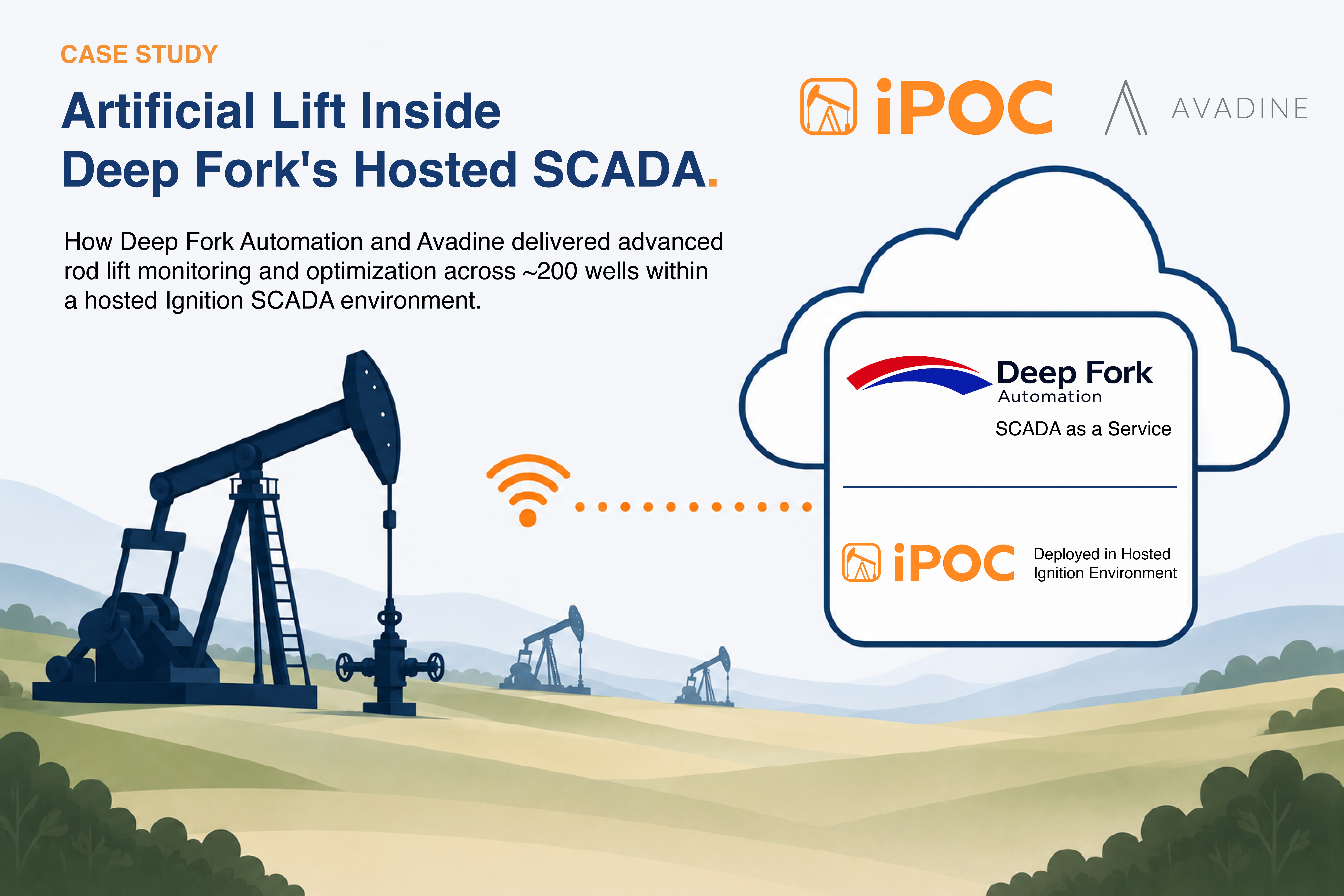
Deep Fork Automation is a SCADA as a Service provider delivering hosted Ignition environments for oil and gas operators. Their model centralizes infrastructure, allowing customers to access SCADA systems without maintaining on-premise deployments.
Deep Fork’s customer operates producing assets requiring reliable artificial lift monitoring and control across its well population. The company needed a better way to monitor and optimize rod lift operations while continuing to work within Deep Fork’s hosted Ignition environment.
Avadine partnered with Deep Fork to deploy iPOC within that environment, extending artificial lift functionality as part of the broader SCADA platform.
The deployment supports approximately 200 wells utilizing Lufkin and SMARTEN pump-off controllers. It integrates directly into Deep Fork’s existing Ignition Gateway and application, using the same proven architectural pattern previously deployed for Magnolia Oil & Gas, adapted for this customer’s scale and device mix.
The Challenge
Improving Rod Lift Monitoring and Optimization
This producer needed better visibility and control across its rod lift assets. While Deep Fork’s hosted Ignition environment already provided SCADA visibility, the existing lift functionality required improvement in feature depth, reliability, and operational clarity.
Traditional or standalone lift optimization systems can introduce additional complexity, including:
- Separate infrastructure or software environments
- Independent communication and polling strategies
- Additional integration effort with SCADA
- Limited alignment with hosted SCADA workflows
- Increased support and maintenance overhead
For Deep Fork, the goal was not to introduce another isolated lift platform. The goal was to improve artificial lift capability inside the existing hosted Ignition architecture.
Maintaining Compatibility with Existing Systems
Deep Fork’s environment already relied on established communication and application architecture. Any artificial lift solution needed to fit that model without forcing major changes to the system.
The deployment needed to:
- Integrate into the existing Ignition Gateway and application
- Align with AutoSol ACM communication workflows
- Support Remote Tag Provider architecture
- Avoid introducing unnecessary system complexity
- Improve rod lift visibility without disrupting existing SCADA operations
Solution
iPOC Deployment Within Deep Fork’s Hosted Ignition Environment
iPOC was deployed within Deep Fork’s existing hosted Ignition environment for this producer, enabling artificial lift monitoring and control to operate as part of the core SCADA application.
The architecture includes:
- AutoSol ACM for communication management
- Remote Tag Provider configuration for centralized data access
- Integration into Deep Fork’s existing Ignition Gateway
- iPOC screens, data, and workflows embedded into the hosted application
This allowed Deep Fork to improve rod lift functionality without introducing a separate standalone lift optimization system.
Stronger Functionality and Reliability
Deep Fork selected iPOC because the cost and value proposition aligned well with the producer’s needs. Compared to the previous approach, iPOC offered more complete functionality, stronger reliability, and a better path forward for hosted rod lift operations.
The result was not a disconnected add-on, but a more capable artificial lift layer inside the same SCADA environment operators were already using.
First Production Lufkin Deployment
This project marked the first production deployment of iPOC supporting Lufkin pump-off controllers.
The deployment supports:
- Lufkin pump-off controllers
- SMARTEN pump-off controllers
- Approximately 200 wells
This expanded iPOC’s production device coverage while proving the platform could be adapted to Deep Fork’s hosted SCADA model without major architectural disruption.
Implementation
The implementation followed a proven Ignition-based deployment model, similar to the architecture used in the Magnolia Oil & Gas deployment, but scaled for the customer’s approximately 200-well environment.
Key implementation activities included:
- Integrating iPOC into Deep Fork’s existing Ignition Gateway and application
- Configuring Remote Tag Providers for centralized data visibility
- Aligning communication workflows with AutoSol ACM
- Supporting Lufkin and SMARTEN controller data
- Validating production monitoring and control workflows
A significant factor in the project was the collaboration between Avadine and Deep Fork. Deep Fork’s feedback emphasized that Avadine listened to their needs and provided a path forward that aligned cleanly with their existing system.
This collaboration allowed the project to move forward without forcing Deep Fork to redesign its hosted SCADA architecture.
Results
Improved Rod Lift Visibility
This producer gained better visibility into rod lift operations within the same Ignition environment already used for SCADA.
Rather than requiring operators to move between disconnected systems, iPOC improved the depth and clarity of lift information inside the existing hosted platform.
More Complete Lift Functionality
Deep Fork identified iPOC as more full-featured and reliable than the previous solution being provided. This strengthened the artificial lift capabilities available to their customer while preserving the benefits of a centralized hosted SCADA environment.
Production-Proven Lufkin Support
The deployment established iPOC’s first production implementation supporting Lufkin controllers, expanding the platform’s field-proven controller compatibility.
This milestone is significant for both Avadine and Deep Fork because it creates a stronger foundation for future rod pump controller deployments.
Scalable Path for Future Customers
The architecture positions Deep Fork to support additional oil and gas customers with artificial lift monitoring and optimization integrated directly into its hosted Ignition platform.
For Deep Fork, iPOC creates an opportunity to deliver a purpose-built artificial lift solution that can evolve alongside customer requirements while remaining tightly integrated with SCADA operations. As iPOC continues to expand support for additional lift methods and controller technologies, Deep Fork is positioned to provide a consistent artificial lift experience across a broader range of production environments.
Conclusion
By partnering with Avadine, Deep Fork Automation was able to extend its hosted Ignition environment with a more capable artificial lift solution for this producer.
The deployment improved lift monitoring and optimization across approximately 200 wells, supported the first production use of iPOC with Lufkin controllers, and strengthened Deep Fork’s ability to deliver artificial lift functionality through its SCADA as a Service model.
This project demonstrates the value of ecosystem-driven collaboration. iPOC did not require Deep Fork to move away from its existing architecture. Instead, it fit directly into the hosted Ignition environment, aligned with established communication workflows, and provided a stronger path forward for artificial lift operations within Deep Fork's hosted SCADA environment.